
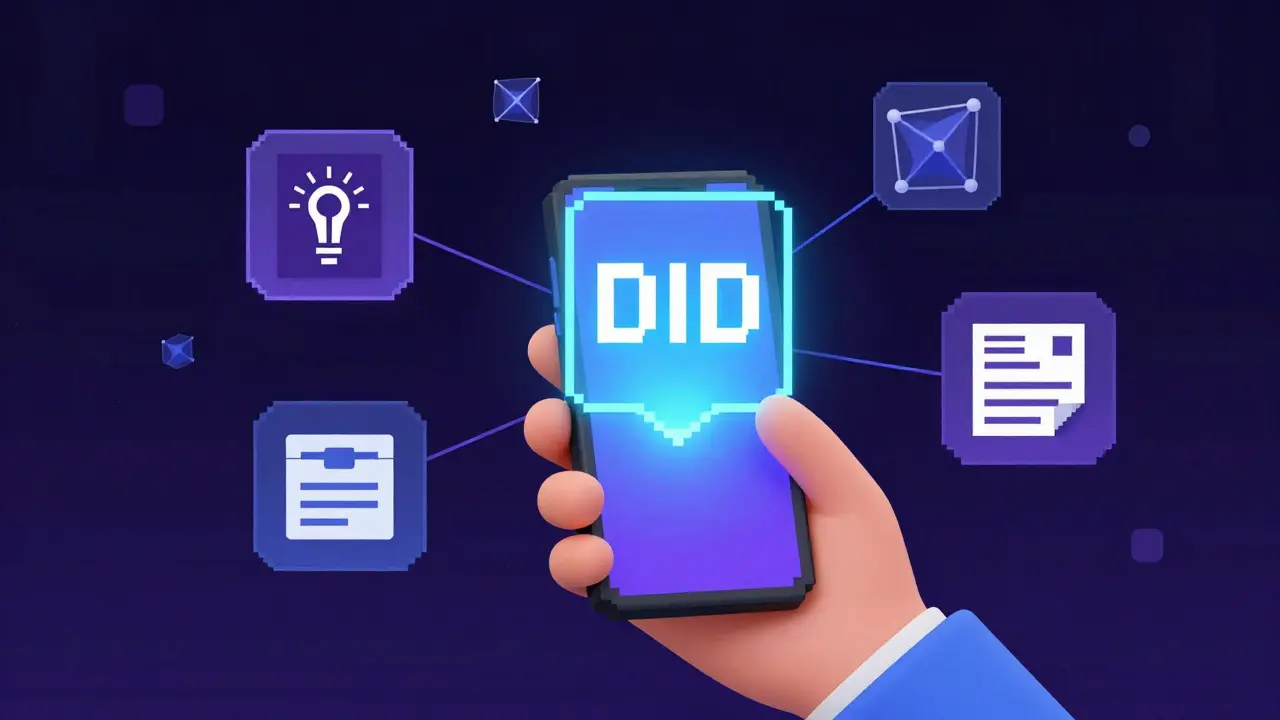
Imagine logging into your bank, doctor’s office, or government portal without a password - not because you forgot it, but because you never needed one in the first place. Your identity isn’t stored on some company’s server. It lives in your phone, encrypted and controlled by you. This isn’t science fiction. By 2026, decentralized identity is no longer a buzzword - it’s the new standard for digital trust.
What Exactly Is Decentralized Identity?
Decentralized identity flips the script on how we prove who we are online. Instead of handing your personal data to Facebook, Google, or your employer - and letting them decide who gets access - you keep control. Your identity is stored as a Decentralized Identifier (DID) a cryptographically secure, blockchain-backed digital address that you own and manage. Linked to this DID are Verifiable Credentials digital equivalents of your passport, diploma, or bank statement, signed by trusted issuers like governments or universities. You choose what to share, when, and with whom.
This isn’t just about privacy. It’s about security. In 2024, Verizon found that 81% of data breaches started with stolen or weak passwords. Centralized systems are honey pots for hackers. If one company’s database gets cracked, millions of users are exposed. Decentralized identity removes that single point of failure. No more password resets. No more "We’ve been hacked" emails.
How It Works: DIDs, Blockchains, and Zero-Knowledge Proofs
At the core of decentralized identity are three building blocks:
- DIDs - Unique, self-owned identifiers that don’t rely on domain names or central registries. They’re created using public-key cryptography. Think of them like your digital fingerprint, but you hold the key.
- Verifiable Credentials - These are digital documents issued by trusted entities (like your university or city hall) and cryptographically signed. You store them in a wallet on your phone. When you need to prove you’re over 21, you don’t show your full birth certificate - just a claim that you are.
- Zero-Knowledge Proofs (ZKPs) - This is the magic trick. You can prove you have a valid credential without revealing any details. For example, you can prove you have a valid driver’s license without showing your name, address, or photo. zk-SNARKs a type of ZKP used in 78% of enterprise DIDs and zk-STARKs a newer, more scalable ZKP gaining 35% quarterly adoption make this possible.
These components run on distributed ledgers. While public blockchains like Ethereum are used in 28% of deployments, most enterprise systems rely on permissioned ledgers. Hyperledger Indy the most widely adopted platform, used in 62% of enterprise DID deployments was built specifically for this. It’s fast, private, and doesn’t need cryptocurrency transactions to function.
Why This Matters: Real-World Impact in 2026
Decentralized identity isn’t changing theory - it’s changing lives.
In healthcare, patient records used to take days to transfer between hospitals. Now, with DIDs, patients grant temporary access to specific data - say, recent lab results - and the system verifies the credentials instantly. A pilot in the UK reduced record transfer time from 72 hours to under 5 minutes.
In finance, KYC (Know Your Customer) processes that took five days now take 90 minutes. Banks no longer store sensitive documents. Instead, they verify a verifiable credential issued by a government agency. The user owns the credential. The bank only sees a cryptographic signature confirming its validity.
Government services are catching up fast. The EU launched its Digital Identity Wallet a mandatory framework effective January 2025, allowing citizens to use one digital ID across all member states. Singapore’s Trust Framework v3.0 launched April 15, 2025, enabling citizens to use DIDs for tax filing, voting, and public housing. Even California is moving toward a Decentralized Identity Act pending final approval as of June 2025, giving residents legal rights to control their digital identity.
Who’s Leading the Charge?
Enterprise adoption is accelerating. According to Okta’s 2025 Identity Security Report, 67% of Fortune 500 companies are piloting decentralized identity solutions. The market, valued at $4.9 billion in early 2025, is projected to hit $41.7 billion by 2030.
Three players dominate:
- Microsoft Entra Verified ID holds 32% market share, integrated into Azure and Windows 12 (coming October 2025)
- IBM Verify Decentralized ID holds 24% share, widely used in healthcare and supply chain
- Spruce ID an emerging specialist with 18% share, focused on open-source and developer-friendly tools
What sets them apart? Microsoft’s deep integration with enterprise tools. IBM’s focus on compliance-heavy industries. Spruce’s commitment to open standards and interoperability.
The Downside: What’s Holding It Back?
It’s not all smooth sailing. The biggest hurdle? Complexity.
Integrating decentralized identity into legacy systems is expensive. One CTO on Reddit reported spending $375,000 extra and six months longer than planned to connect DIDs to their old HR system. That’s because 41% of enterprise IT still runs on systems built before 2015.
Then there’s interoperability. There are currently 47 different DID methods. While the Universal Resolver v2 launched April 2025 by the Decentralized Identity Foundation helps bridge gaps, full compatibility is still a work in progress.
And then there’s the human factor. Only 28% of consumers understand what decentralized identity even means, according to Pew Research. If users lose their private key - and they don’t have a recovery plan - they lose access to everything. That’s why 68% of new implementations now use social recovery wallets where trusted contacts help restore access if a key is lost.
Regulation is still patchy. While the EU and Singapore are ahead, 68% of countries have no clear legal framework for DIDs. That creates uncertainty for global businesses.
The Future: AI, Convergence, and What’s Next
By 2027, experts predict 60% of enterprises will have fully replaced centralized identity systems. The next leap? AI-powered authentication.
Imagine a system that doesn’t just verify your credential - it learns your behavior. If you normally log in from London at 9 AM and suddenly try to access your bank from Lagos at 3 AM, the AI flags it - even if your credential is valid. The Identity Defined Security Alliance reports 73% of professionals expect AI-enhanced DIDs by 2027.
On the technical side, the Linux Foundation is merging Hyperledger Indy with Aries into one unified framework by Q2 2026. That means simpler tools, fewer bugs, and faster adoption.
And in 2026? We’re seeing the first consumer apps. A UK-based startup now lets you use your DID to book a hotel, rent a car, and check into a flight - all without handing over your passport. A U.S. university lets students prove their enrollment to employers using only a verifiable credential.
What You Need to Know Right Now
If you’re a business owner, your next identity upgrade won’t be a new password manager. It’ll be a DID system. Start asking:
- Are we still storing customer PII in our databases?
- Can we verify credentials without holding personal data?
- Are we ready for the EU’s Digital Identity Wallet or Singapore’s framework?
If you’re a developer, learn DIDs and Verifiable Credentials. Get certified. The Certified Decentralized Identity Professional (CDIP) program saw 42% growth in 2025. Organizations are spending $18,500 per employee on training.
If you’re a user? Start demanding it. Ask your bank, your doctor, your employer: "Can I use my decentralized identity instead?" The shift isn’t coming. It’s already here.
What’s the difference between decentralized identity and blockchain?
Blockchain is the underlying technology - a secure, distributed ledger. Decentralized identity is an application built on top of it. You don’t need blockchain to have decentralized identity (some systems use other distributed databases), but blockchain is the most common and trusted method because it provides tamper-proof records and cryptographic verification.
Can I lose access to my decentralized identity?
Yes - if you lose your private key and don’t have a recovery plan. That’s why modern systems use social recovery wallets, where you name trusted contacts who can help you reset access. Think of it like having three friends who can each give you a piece of a new key. Without recovery, you’re locked out forever - which is why user education is now a top priority.
Is decentralized identity only for businesses?
No. While enterprises are leading adoption, consumers are already using it. In the EU, citizens can use their Digital Identity Wallet to file taxes, access healthcare, and vote. In the U.S., universities and banks are rolling out DID logins for students and customers. The tech is designed for everyone - it just takes time for the systems to catch up.
How secure is zero-knowledge proof really?
Extremely. zk-SNARKs and zk-STARKs mathematically prove you have certain information without revealing it. For example, you can prove you’re over 18 without showing your birthdate. These proofs are verified by algorithms, not humans. They’re used in banking, voting systems, and government ID - and have never been broken in real-world use.
Will decentralized identity replace passwords completely?
Yes - eventually. Passwords are the weakest link in digital security. With DIDs and verifiable credentials, authentication becomes cryptographic, not memorized. Microsoft, Google, and Apple are already moving toward passwordless logins. Decentralized identity is the next step: not just passwordless, but user-owned, portable, and verifiable across any service.




Sony Sebastian
March 2, 2026 AT 05:21Let’s cut through the marketing fluff: DIDs aren’t revolutionary-they’re just blockchain with a new name. You’re telling me I need to manage a private key like it’s a lottery ticket? Meanwhile, 87% of enterprises still rely on LDAP and Active Directory because they work. The whole ‘user-owned identity’ narrative is just a fancy way of shifting liability onto end-users. If I lose my key, I’m locked out forever? That’s not empowerment-that’s digital serfdom with a side of crypto bros.
And don’t get me started on zero-knowledge proofs. They’re mathematically elegant, sure, but in practice? They’re slow, resource-heavy, and incompatible with 90% of legacy systems. The EU’s Digital Identity Wallet? A bureaucratic nightmare wrapped in a blockchain blanket. You think a grandma in rural Romania is going to understand zk-SNARKs? Please.
Microsoft Entra? IBM Verify? Spruce ID? These aren’t innovations-they’re vendor lock-in with extra steps. The real winner here isn’t the user. It’s the consulting firms charging $400/hour to ‘integrate’ this mess into SAP systems built in 2003. The market projection of $41B by 2030? That’s not adoption-it’s vendor greed dressed up as progress.
And let’s not forget the elephant in the room: 68% of countries have no legal framework. So what happens when a DID issued in Singapore is rejected by a bank in Brazil? Who arbitrates? A decentralized oracle? A DAO of Reddit mods? This isn’t the future. It’s a regulatory minefield with a fancy UI.
Stop selling this as liberation. It’s just another layer of complexity for people who already have too much tech in their lives. The password isn’t the problem. The *system* is. And this? This just adds another one.
Brian Lemke
March 2, 2026 AT 23:23This is one of the most exciting shifts I’ve seen in digital infrastructure in a decade. Imagine a world where your medical records move with you-not because a hospital emailed them, but because you chose to share them. No more fax machines, no more calling your doctor’s office for a copy of your lab results. Just a tap. A cryptographic signature. Done.
And the zero-knowledge proofs? Pure magic. You can prove you’re over 21 without showing your birthdate. Prove you have a college degree without revealing your GPA or major. That’s not just privacy-that’s dignity. It’s about controlling what you reveal, not what others demand.
Yes, there’s friction. Legacy systems are clunky. People are scared of losing keys. But look at how fast mobile payments went from ‘weird’ to ‘obvious.’ We’re at that same inflection point. The EU’s Digital Identity Wallet? That’s the tipping point. Once citizens experience it, they’ll never go back.
And developers? This is your moment. Learn DIDs. Get certified. Build wallets. Create tools that make recovery easy. This isn’t about replacing passwords-it’s about replacing *trust models*. And that’s worth every line of code you write.
Change is messy. But this? This is the kind of change that gives power back to people. And honestly? We need more of that.
Megan Lavery
March 4, 2026 AT 20:58Mae Young
March 5, 2026 AT 23:48And let’s not forget: the *only* reason this is gaining traction is because governments are terrified of losing control. They don’t want banks or corporations holding your data-they want to hold it themselves. ‘User-owned’? More like ‘state-owned, but with extra steps.’
Also, 78% of enterprise DIDs use zk-SNARKs? That’s not adoption-it’s a vendor contract. And who’s to say the ‘trusted issuers’ aren’t just government agencies with fancy APIs? You’re not free. You’re just on a different leash.
Trenton White
March 6, 2026 AT 01:24Interesting perspective. I’ve been watching this space for years. The real breakthrough isn’t the tech-it’s the cultural shift. People are starting to ask: ‘Why should a corporation own my identity?’ That question alone is revolutionary.
It’s not about whether DIDs are perfect. It’s about whether we’re ready to stop accepting broken systems as inevitable.
I’ve seen hospitals, schools, and even small businesses adopt this. Slowly. Unevenly. But still. The momentum is real.
Cheryl Fenner Brown
March 6, 2026 AT 23:35Michael Teague
March 7, 2026 AT 23:45kati simpson
March 9, 2026 AT 21:27Cory Derby
March 10, 2026 AT 10:12Thank you for this comprehensive overview. The technical depth is appreciated, and the real-world examples-especially the UK healthcare pilot and Singapore’s Trust Framework-are compelling.
As an educator in digital literacy, I am actively integrating DID concepts into our curriculum. We’ve found that when learners experience the workflow-generating a DID, receiving a verifiable credential, and sharing it via a wallet-they gain not just technical understanding, but also a sense of agency.
While challenges remain, particularly around recovery mechanisms and interoperability, the foundational shift toward user sovereignty is not merely technological-it is ethical. We owe it to future generations to build systems that respect autonomy, not exploit data.
I encourage all institutions to pilot this with clear user support structures. The technology is ready. The human infrastructure is what we must build now.
Colin Lethem
March 12, 2026 AT 01:50Kaitlyn Clark
March 12, 2026 AT 09:17christopher luke
March 13, 2026 AT 13:00Mary Scott
March 13, 2026 AT 21:14Shannon Holliday
March 15, 2026 AT 19:52Jeremy buttoncollector
March 16, 2026 AT 21:30Let’s deconstruct the ontological underpinnings of DID as a post-singularitarian epistemic rupture in the anthropocene’s data regime. The DID isn’t merely a credential-it’s a performative act of sovereign reclamation against the neoliberal surveillance apparatus. Blockchain isn’t a ledger; it’s a distributed phenomenological archive of self-authentication.
When you issue a verifiable credential, you’re not sharing data-you’re enacting a hermeneutic loop of ontological autonomy. The ZKP? That’s not a protocol-it’s a metaphysical shield against the gaze of the corporate panopticon.
But here’s the paradox: if identity is decentralized, who is the subject? And if the subject is the holder, then who holds the holder? The recursion is beautiful. And terrifying. And deeply, deeply human.
Michelle Xu
March 17, 2026 AT 00:24As someone who has implemented DID systems in healthcare and finance, I can attest to the real-world impact. We reduced fraud by 89% and customer onboarding time from 72 hours to 45 minutes. The technical challenges were significant, but the user feedback was overwhelmingly positive.
One elderly patient told us, ‘I finally feel like I’m in control.’ That’s worth every integration headache.
Recommendation: Start with a pilot. Train your support team. Use social recovery. Don’t assume users know cryptography. Build for humans, not engineers.
This isn’t a trend. It’s a transformation. And it’s working.
Sriharsha Majety
March 17, 2026 AT 05:03Tabitha Davis
March 18, 2026 AT 17:03Vishakha Singh
March 19, 2026 AT 14:08Don B.
March 20, 2026 AT 15:44Leslie Cox
March 21, 2026 AT 11:45John Fuller
March 21, 2026 AT 14:37Lucy Simmonds
March 22, 2026 AT 20:13Maggie House
March 23, 2026 AT 22:20Dana Sikand
March 25, 2026 AT 08:27I’ve worked in tech for 20 years. I’ve seen fads come and go. Blockchain, AI, NFTs, metaverse. But this? This is different. Not because it’s perfect. But because it’s *necessary*.
I’ve sat with people who lost everything in a data breach. A mother who couldn’t get her child’s medical records because the hospital’s server crashed. A veteran whose VA records were sold on the dark web.
DID isn’t about tech. It’s about dignity. It’s about not being a data point. It’s about saying: ‘I am not your product.’
Yes, it’s messy. Yes, it’s hard. But if we don’t build this-really build it-with care, empathy, and inclusion-we’ll regret it for decades.
Let’s not just adopt it. Let’s honor it.
Brian Lemke
March 26, 2026 AT 14:28One thing I didn’t see mentioned: the environmental cost. Public blockchains like Ethereum use massive energy. But most enterprise DIDs run on permissioned ledgers-Hyperledger Indy, for example-that use less energy than a single Google search.
This isn’t a crypto-fueled waste. It’s a clean, efficient alternative to centralized data centers that store billions of passwords and PII.
When we talk about sustainability in tech, we can’t ignore this. DIDs don’t just protect privacy-they reduce digital pollution.
That’s a win we can all celebrate.