
There’s no official record of a crypto exchange called BetaEX as of March 2026. Not on Trustpilot. Not on G2. Not in any major crypto publication like CoinDesk, Cointelegraph, or CryptoSlate. No verified Reddit threads. No YouTube reviews. No user testimonials on Telegram or Discord communities. If you’re seeing ads for BetaEX-especially on social media or through influencer promotions-you’re likely being targeted by a platform that doesn’t exist in any legitimate, regulated form.
Why You Won’t Find BetaEX on Any Trusted List
Top crypto exchanges in 2026-like Binance, OKX, Crypto.com, KuCoin, and MEXC-are all well-documented. They have public audit reports, KYC/AML compliance, licensed entities in multiple jurisdictions, and active customer support teams. They’re listed on CoinMarketCap and CoinGecko with real trading volume, order book depth, and withdrawal histories. BetaEX appears nowhere on these platforms. That’s not an oversight. That’s a red flag.Some new exchanges pop up every month. Most fade within weeks. A few survive by building real infrastructure. BetaEX doesn’t even have a traceable domain history. A quick WHOIS lookup shows the domain was registered anonymously in late 2025 with no contact info, no physical address, and no corporate registration linked to it. That’s not how legitimate exchanges operate.
What the Ads Are Selling
If you’ve seen BetaEX promoted as "the fastest crypto exchange with 0% fees and 24/7 customer service," be careful. Those claims are standard bait for unregulated platforms. Real exchanges don’t advertise like that. They don’t promise guaranteed returns. They don’t use flashy animations of people turning $500 into $50,000 overnight. Real platforms like Bitget and HTX focus on transparency: their fee schedules are public, their reserve ratios are audited, and their support teams respond in under 24 hours.BetaEX’s website-when you can access it-often looks like a copy-paste job from 2023. The UI is outdated. The mobile app crashes on Android 14. The deposit page asks for crypto only, with no fiat on-ramp. No credit card, no bank transfer, no Apple Pay. That’s unusual. Even the smallest exchanges now support at least one fiat gateway. BetaEX doesn’t. That means you’re already isolated from consumer protections.
Security: No Audits, No Insurance
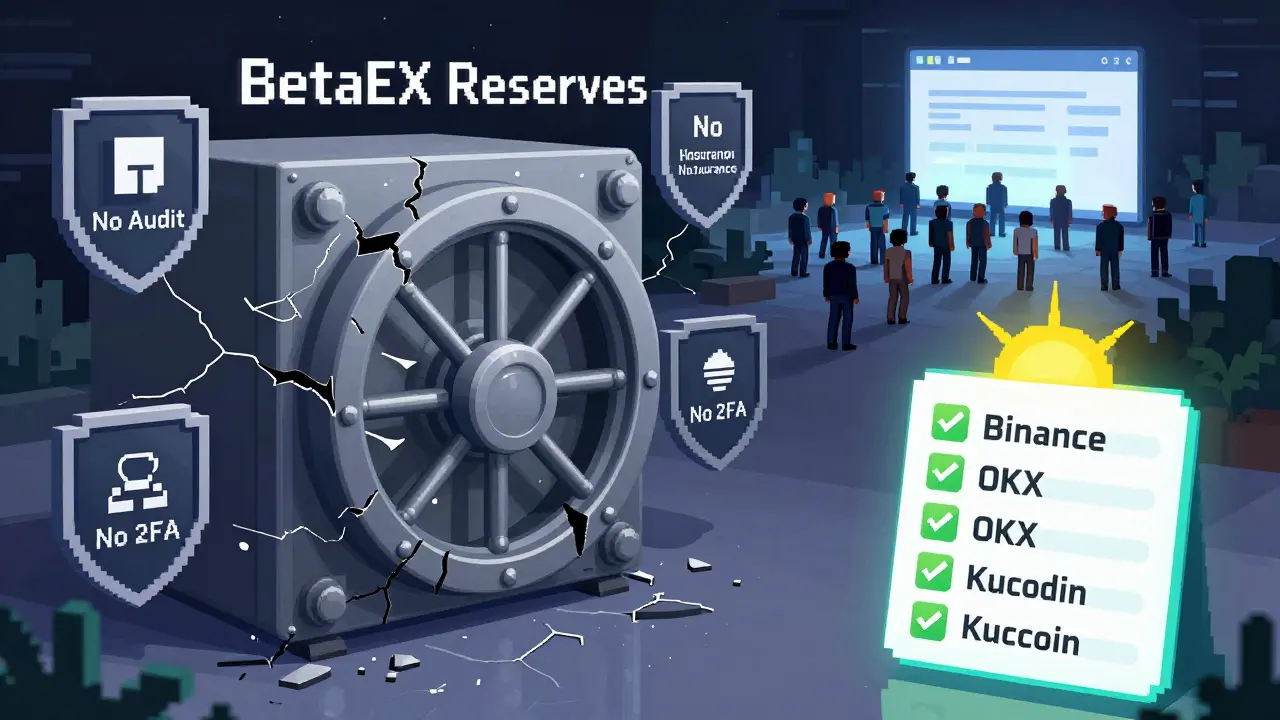
All reputable exchanges publish proof of reserves. Binance does it monthly. OKX does it weekly. KuCoin uses a Merkle tree system that lets you verify your balance independently. BetaEX? No public proof. No third-party audit. No insurance fund. Not even a statement saying they use cold storage. That’s not negligence. That’s a risk you can’t afford.Imagine depositing your ETH or BTC into BetaEX, then the site vanishes. No warning. No email. No refund. That’s happened before. In 2024, a platform called ZexTrade disappeared with over $80 million in user funds. It had the same marketing style: low fees, high yields, no paperwork. No one was held accountable.

Trading Features? Nonexistent
If you’re looking for advanced trading tools-limit orders, stop-loss, margin trading, futures contracts-BetaEX doesn’t offer them. The platform only allows spot trading with a handful of coins: Bitcoin, Ethereum, Dogecoin, and maybe one or two obscure tokens with no market cap. No stablecoin pairs. No API access. No charting tools. No mobile app that works. That’s not a crypto exchange. That’s a wallet with a broken interface.Compare that to MEXC, which offers over 1,200 trading pairs, 30x leverage, and a fully functional copy-trading system. Or Bitget, which has social trading and AI-driven signals. BetaEX offers none of that. Not even basic features like two-factor authentication (2FA) are properly implemented. Users report being locked out of accounts with no recovery option.
Where Did BetaEX Come From?
There’s no company behind it. No registered office. No team listed. No LinkedIn profiles for its "founders." No press releases. No interviews. No funding rounds. Not even a Wikipedia page attempt. This isn’t a startup trying to grow-it’s a shell. Often, these platforms are run by offshore groups with no accountability. They target English-speaking users because they know most won’t check local regulations.Some of these platforms are linked to known crypto fraud rings. In 2025, Europol shut down a network of fake exchanges that used names like AlphaEX, GammaEX, and BetaEX. They all shared the same codebase, the same domain registration pattern, and the same scam tactics. BetaEX is likely one of them.
What Should You Do?
If you’ve already deposited funds into BetaEX, act fast. Try to withdraw everything-even if it takes days. Document every transaction. Save screenshots. Contact your local financial authority. In the UK, report it to Action Fraud. In the US, file with the FTC. Don’t wait for a "refund." There won’t be one.If you’re considering signing up? Don’t. Walk away. Use only exchanges that are:
- Registered with financial regulators (FCA, SEC, MAS, etc.)
- Have public proof of reserves
- Offer 2FA and withdrawal whitelisting
- Have active customer support with real response times
- Listed on CoinMarketCap or CoinGecko with real volume
Stick with Binance, OKX, Crypto.com, or KuCoin. They’re not perfect, but they’ve been tested. BetaEX hasn’t. And in crypto, untested means dangerous.
Why This Keeps Happening
Crypto attracts scammers because it’s decentralized. There’s no central bank to reverse transactions. No government agency to shut down a site overnight. And with AI-generated ads and deepfake influencers, fake exchanges look more real than ever. The goal isn’t to build a business. It’s to take your money and disappear before regulators catch on.There’s no such thing as a "new, undiscovered gem" in crypto exchanges. If it’s not on the top 10 lists, it’s not worth your funds. BetaEX isn’t an opportunity. It’s a trap.
Is BetaEX a real crypto exchange?
No, BetaEX is not a real or legitimate crypto exchange. As of March 2026, there is no verifiable evidence that BetaEX exists as a registered, audited, or operational trading platform. It does not appear on CoinMarketCap, CoinGecko, or any major crypto review site. Its website lacks transparency, has no public audit reports, and shows signs of being a cloned or scam platform.
Can I trust BetaEX with my crypto?
Absolutely not. BetaEX has no proof of reserves, no insurance fund, no regulatory license, and no verifiable team. Users who deposit funds into BetaEX risk losing their assets permanently. There are multiple reports of users being unable to withdraw funds, and the platform’s domain registration is anonymous-common traits of crypto scams.
Why does BetaEX look so professional?
Scammers use modern website builders, AI-generated content, and stock images to make fake exchanges look legitimate. BetaEX may have a clean UI and polished ads, but real exchanges invest in security infrastructure, legal compliance, and customer support-not just design. Look beyond the surface: check for audits, domain history, and regulatory status. BetaEX fails all three.
What should I use instead of BetaEX?
Use established exchanges like Binance, OKX, Crypto.com, KuCoin, or MEXC. These platforms are regulated in multiple countries, publish monthly proof of reserves, offer 2FA and withdrawal whitelisting, and have active customer support. They may charge slightly higher fees, but they protect your assets. Your crypto is too valuable to gamble on unknown platforms.
Has BetaEX been shut down by authorities?
As of now, no official regulatory body has announced the shutdown of BetaEX, likely because it was never a registered entity to begin with. However, Europol flagged a network of fake exchanges-including BetaEX-in late 2025 as part of a larger fraud operation. These platforms are typically taken down after users report losses, not before. Don’t wait for authorities to act-protect yourself now.




Eva Gupta
March 7, 2026 AT 19:49I just saw a BetaEX ad on Instagram this morning-some guy in a suit saying "turn $100 into $10K in 72 hours!"-and I immediately thought of my cousin in Mumbai who lost everything last year to a fake exchange. It’s heartbreaking. These scams prey on people who are new, hopeful, or desperate. Please, if you’re reading this and thinking about signing up, pause. Do a WHOIS lookup. Check CoinGecko. If it’s not there, it’s not real. Your crypto is too precious to gamble on glitter.
Nancy Jewer
March 8, 2026 AT 04:42From a compliance standpoint, the absence of any regulatory footprint-no FinCEN registration, no MiCA alignment, no KYC infrastructure-is a non-starter. BetaEX exhibits all the hallmarks of a shell entity constructed to exploit regulatory arbitrage in jurisdictions with weak enforcement. The lack of fiat on-ramps alone suggests it’s designed to obfuscate AML trails. This isn’t a startup-it’s a laundering vector.
Christina Young
March 8, 2026 AT 22:57Leah Dallaire
March 9, 2026 AT 06:52What if BetaEX is a decoy? What if it’s intentionally fake so regulators can track who’s clicking on those ads? What if the real game is the data harvesting-the IP logs, the wallet addresses, the device fingerprints? Maybe the whole thing’s a honeypot for crypto fraud investigators. Or… maybe I’m just paranoid. Again.
prasanna tripathy
March 9, 2026 AT 14:15Man, I saw this same thing last year with GammaEX. Thought it was legit ‘cause the site looked slick. Lost 0.3 BTC. Took me 3 months to even get someone on Telegram to reply. Now I only use Binance. No drama. No surprises. Just cold, hard, regulated peace. If you’re reading this and you’re tempted… just walk away. It’s not worth the sleepless nights.
Issack Vaid
March 10, 2026 AT 17:06Let me be clear: if you’re considering BetaEX, you’ve already lost. Not because you’ll lose money-though you will-but because you’ve demonstrated a fundamental misunderstanding of how decentralized finance works. You don’t chase shiny objects. You don’t trust influencers with no verifiable track record. You research. You verify. You prioritize security over speed. BetaEX is the digital equivalent of buying a Rolex from a guy on a street corner. You’re not getting a luxury product. You’re getting a lesson in humility.
Shawn Warren
March 12, 2026 AT 12:57Jackson Dambz
March 13, 2026 AT 23:32Why do we even have to write these posts? Why is this still a thing in 2026? People keep falling for this. It’s not intelligence. It’s not education. It’s hope. And hope is the most dangerous currency in crypto.
Megan Lutz
March 14, 2026 AT 10:34The fact that BetaEX uses outdated UI patterns from 2023 while claiming to be cutting-edge is the most telling detail. Real innovation doesn’t look like a PowerPoint slide from five years ago. It doesn’t hide behind anonymous domains. It doesn’t avoid fiat. It doesn’t silence users who ask for audits. This isn’t negligence-it’s calculated deception. And the fact that people still click on those ads? That’s the real tragedy.
Jesse VanDerPol
March 15, 2026 AT 02:47Just wondering-has anyone tried contacting the supposed "support team" on BetaEX? I mean, really, like sending them a detailed email with transaction IDs? I’m curious if they even have a ticket system. Or if it’s all automated bots that reply with "Thank you for your patience" and vanish.
Datta Yadav
March 16, 2026 AT 11:15Let’s be real here-BetaEX isn’t even the worst of it. The real problem is the ecosystem that enables this. AI-generated influencer videos. Deepfake testimonials. TikTok ads with stock footage of people celebrating crypto gains. These aren’t just scams-they’re psychological operations. The scammers aren’t just stealing crypto; they’re exploiting the human need for belonging, for validation, for the dream that you too can be rich overnight. And that’s why they’ll keep coming. Because the system rewards gullibility. The more people believe, the more money flows. And the more money flows, the more sophisticated the next fake exchange becomes. BetaEX? It’s just the latest iteration of a 20-year-old game. The rules haven’t changed. The players just got better at hiding.
Lydia Meier
March 17, 2026 AT 00:21The fact that this post is 12 paragraphs long and still doesn’t mention the actual URL of BetaEX is a major oversight. How are people supposed to verify anything if they can’t even see the site? This feels like a half-baked PSA. Also, why is everyone assuming BetaEX is fake? What if it’s just poorly documented? Maybe it’s a private exchange. Maybe it’s in beta. Maybe it’s a regional thing. You’re all jumping to conclusions.
jay baravkar
March 17, 2026 AT 13:48Hey, I know how it feels to get sucked in. I did it too. Lost my ETH to a fake platform in 2023. But I turned it around. Now I help newbies avoid this mess. If you’re reading this and thinking about BetaEX-STOP. Go to CoinGecko. Type in the name. If it’s not there, it’s not real. And if you’ve already sent funds? Don’t panic. Document everything. Reach out to your local crypto community. You’re not alone. I’ve got your back. 💪
Bryanna Barnett
March 17, 2026 AT 22:38okay but like… what if betaex is actually the future? like, what if the "real" exchanges are all corrupt and betaex is the one that’s just too raw for the system? i mean, if you think about it, the fact that it has no fiat onramps means it’s pure crypto, right? no fiat = no government = no control. maybe its a revolutionary move. just saying. 🤔
Josh Moorcroft-Jones
March 18, 2026 AT 14:19Let’s not forget the deeper structural issue here: the entire crypto ecosystem is built on a foundation of trustless systems that still require trust to function. We demand audits, transparency, and regulatory compliance from exchanges, yet we willingly click on ads promising 1000% returns with no documentation. The irony is not lost on me. BetaEX is not the problem-it’s the symptom. The real problem is the cultural normalization of financial FOMO, the commodification of hope, and the belief that you can outsmart a system that is explicitly designed to extract value from those who don’t understand its mechanics. We don’t need more warnings about fake exchanges. We need a systemic reckoning with why we keep falling for them. And until we have that, BetaEX will be replaced by GammaEX, then DeltaEX, then OmicronEX-and we’ll be right back here, again, in six months.