OKX Fees – What You Need to Know Before You Trade
When you look at OKX fees, the set of charges OKX applies to spot, futures, options and other services. Also known as OKX trading costs, it determines how much of your profit stays in your wallet after a trade.
Understanding trading fees, the per‑transaction costs that vary by product and volume is the first step. Within that umbrella you’ll meet the maker fee, the lower rate you pay when you add liquidity to the order book and the taker fee, the higher rate charged when you remove liquidity. Both fees follow a tiered structure: the more you trade each month, the lower your rate drops. OKX also offers a fee discount, rebates or reductions linked to holding OKB or using VIP programs, turning a regular trader into a cost‑effective one.
How the fee system works in practice
First, every spot trade starts with a base maker‑taker split of 0.10% / 0.15% for most pairs. If you place a limit order that sits on the book and later fills, you’re a maker and enjoy the 0.10% rate. Market orders or instant fills make you a taker, so you pay the 0.15% rate. For futures contracts, the rates shrink a bit – 0.02% / 0.05% – but the maker‑taker principle stays the same.
Second, the tiered volume discounts kick in once your 30‑day trading volume crosses certain thresholds. For example, moving from 0‑10 BTC to 10‑50 BTC per month can shave 0.02% off both maker and taker rates. Holding OKB, the native token, gives an extra 10‑15% discount on top of the volume tier, effectively turning a 0.10% maker fee into roughly 0.085%.
Third, fee rebates can offset costs further. OKX runs periodic rebate campaigns where active traders receive a cash‑back credit based on their net volume. These rebates are paid in USDT or OKB, letting you recoup a portion of the fee you just paid.
All these pieces—base rates, volume tiers, token‑hold discounts and rebates—form a network of relationships that shape your overall cost. In short, OKX fees aren’t a flat number; they evolve with your activity and token holdings.
Now that you’ve got the fundamentals, the articles below break down each element in detail, compare OKX’s costs with other major exchanges, and show you how to calculate the exact fee you’ll pay on any trade. Dive in to see real‑world examples, fee‑saving tips, and the latest updates to OKX’s pricing model.
OKX Korea Review: Fees, Security, and How to Trade in South Korea
By Robert Stukes On 15 Sep, 2025 Comments (14)
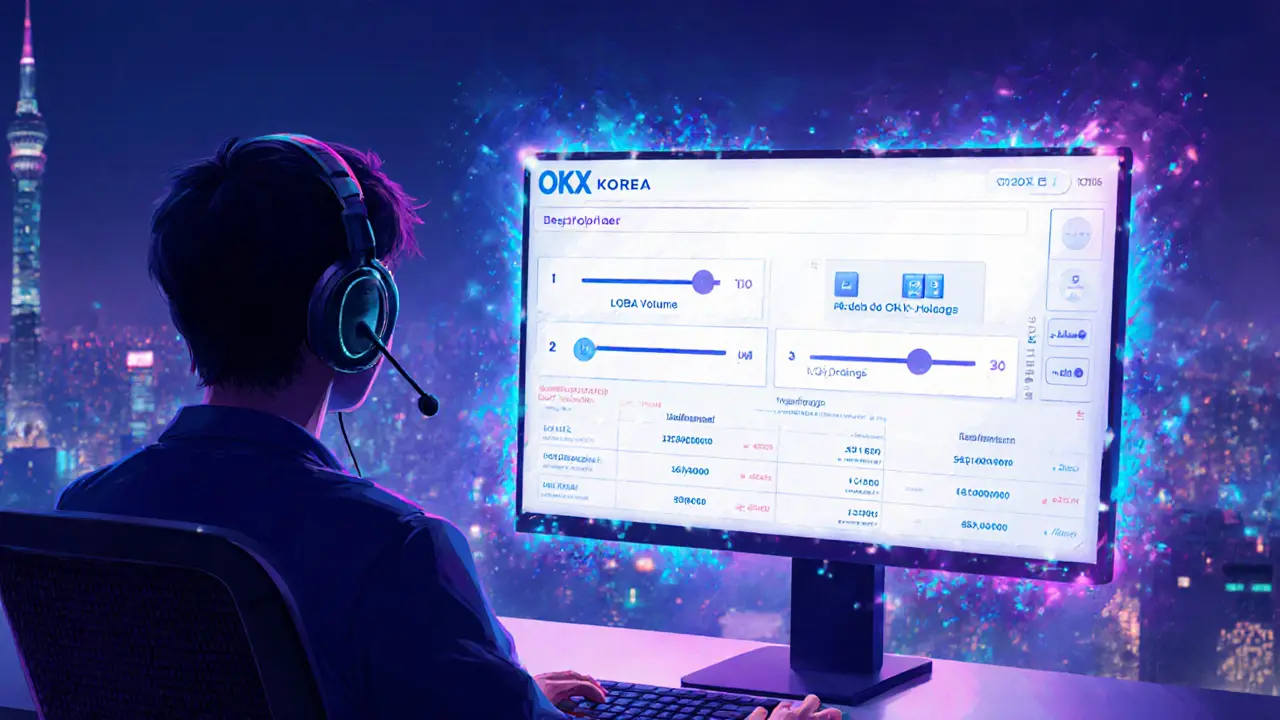
A detailed OKX Korea review covering fees, security, KRW support, account setup, pros and cons, and a comparison with local exchanges for South Korean traders.
View More